
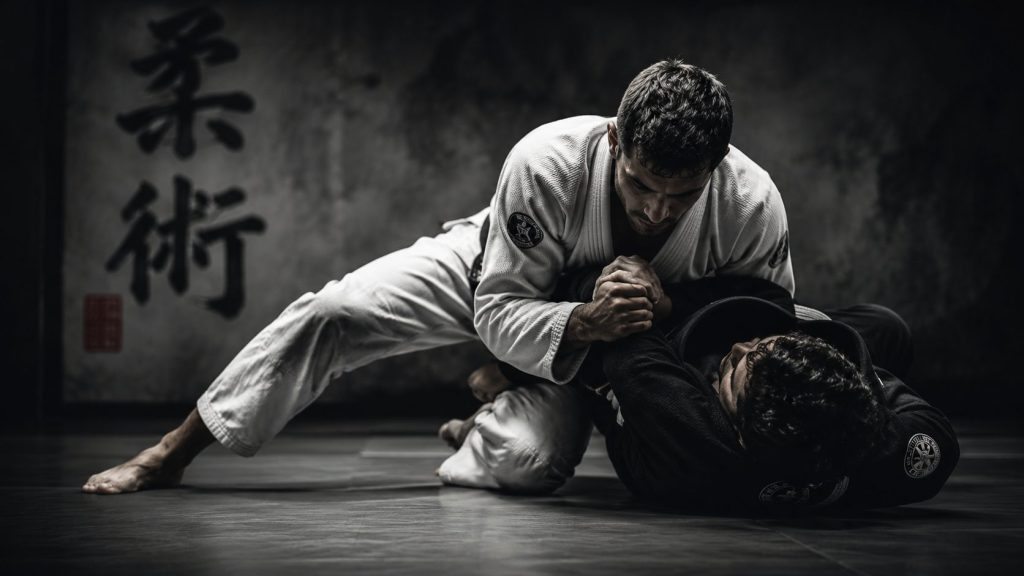
Walk into any academy and you’ll find two kinds of white belts: the ones chasing the flashy stuff they saw on Instagram (inverted heel hooks, berimbolos, worm guard) and the ones drilling hip escapes and framing until it’s boring. Years later, it’s almost always the second group still on the mats, and it’s usually their armbar, their triangle, and their rear naked choke that are doing the finishing. Jiu-jitsu has no shortage of exotic systems, but the data, the highest-level competitors, and the instructors who’ve trained them all point to the same uncomfortable truth: the sport is won and lost on fundamentals.
The numbers don’t lie
At the 2023 IBJJF World Championships, 45% of all submissions were the rear naked choke. The armbar accounted for another 21%. Between them, those two techniques, taught in literally every beginner’s first month of training, made up two-thirds of every finish at the highest level of gi competition on earth. Widen the lens slightly and it gets more striking: five techniques (armbar, rear naked choke, triangle choke, guillotine, and kimura) account for over 56% of all submissions across IBJJF competition. Every one of those is a white-belt-curriculum technique.
This isn’t a fluke of one tournament. It holds up year over year, across belt levels, gi and no-gi. The submissions that finish black belt world champions are the same submissions taught to a person in their first week of class. What separates the champion from the beginner isn’t a different technique; it’s a different relationship to the same technique.
Advanced jiu-jitsu is fundamentals executed under pressure
The phrase “there are no advanced techniques, only advanced execution of fundamentals” gets repeated so often in BJJ circles it’s become a cliché, but it holds up under scrutiny. Look at any high-percentage submission and you’ll find it’s built entirely out of positional fundamentals:
An armbar from mount is really just weight distribution, hip control, and isolating one limb, the same principles taught on day one, applied with better timing and tighter control. A triangle choke is fundamentally an angle problem: getting your hips off-line and your legs configured correctly is 90% of the finish, and that’s a hip-mobility and framing skill, not a secret technique. A rear naked choke is back control plus seatbelt grip plus patience, three concepts every white belt learns before their first stripe. Even a guillotine, one of the most instinctive submissions in the sport, is really just an underhook, a grip, and correct hip positioning to prevent the escape.
Strip away the branding and most “advanced” submissions are a fundamental positional principle (base, posture, hip escape, framing, grip control) executed against a resisting opponent who is actively trying to prevent it. That’s the whole game. The technique doesn’t change; the resistance does.
What the best coaches keep saying
This isn’t just competition statistics; it’s the explicit philosophy of the people who’ve produced the most dominant grapplers of the last decade. John Danaher, who coached Gordon Ryan, Garry Tonon, and the rest of the Danaher Death Squad through a run of near-total dominance in no-gi grappling, has said plainly: “Focus on the basics; they’re the building blocks of advanced maneuvers.” His entire instructional catalog is built around the idea that a small number of positional principles (back control, leg entanglements, pressure passing) generate the vast majority of a grappler’s offense once truly understood.
Saulo Ribeiro, a multiple-time world champion and one of the sport’s most respected teachers, is even more direct about it: “Mastery in jiu-jitsu is found in the fundamentals.” He’s also said, “When I see you grapple, I am not impressed if you win or lose. What I want to see is your use of the fundamentals of jiu-jitsu,” a standard that judges skill not by outcome but by how cleanly someone applies base, posture, and control under pressure.
Why fundamentals hold up when everything else breaks down
There’s a practical reason fundamentals dominate at the highest level: they’re the techniques that work regardless of your opponent’s game plan. Exotic guard systems and low-percentage submissions tend to be counters to specific styles; they work great against someone who doesn’t know how to defend them, and they evaporate against someone who does. Hip escapes, framing, grip fighting, and the core submissions built on top of them don’t have that vulnerability. A tight armbar from mount is a threat against literally anyone, at any belt level, in any ruleset, because it’s not exploiting a gap in a specific system, it’s exploiting basic human anatomy.
Fundamentals are also what hold up when a match gets physical, tired, or chaotic, which is most of them. Complex sequences require a cooperative or surprised opponent and a clear head. Under real pressure, in the third minute of a hard round, technique quality collapses toward whatever’s most deeply ingrained, which is exactly why coaches drill hip escapes and framing thousands of times rather than a few dozen. The rear naked choke wins 45% of the time at Worlds not because elite competitors can’t do anything fancier, but because it’s the technique everyone in the room can execute reliably even when things get ugly.
The takeaway for anyone on the mats
None of this means advanced systems and modern innovations don’t matter. Leg lock systems, modern guard retention, and back-take sequences have genuinely evolved the sport. But they’re additions built on top of a foundation, not a replacement for it. A practitioner with a truly excellent hip escape, solid base and posture, and a crisp armbar-triangle-RNC trio will beat someone with a flashier but shallower game more often than not, at every belt level from blue to black. That’s not old-fashioned thinking; it’s what the tournament data and the sport’s best coaches have been saying for years. Drill the basics until they’re automatic, and the submissions will take care of themselves.