
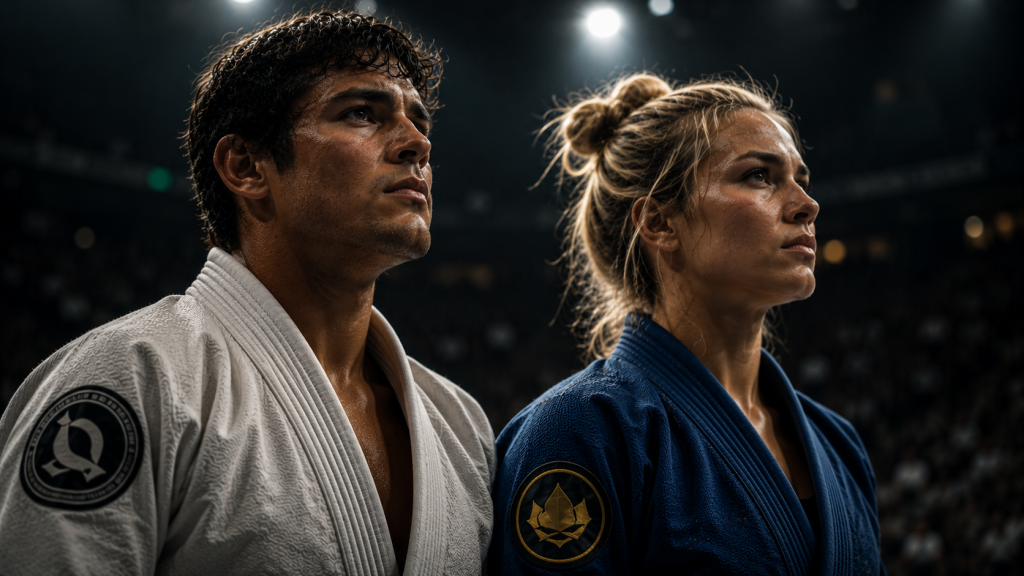
There is a particular kind of person who will board a plane alone, travel across the country, and step onto a mat in front of a crowd that mostly doesn’t know their name. No fanfare. No guarantee of a win. No certainty of anything except that the moment they’ve been training for is finally here. To the outside world, it might look like an ordinary weekend. To the Brazilian Jiu-Jitsu competitor, it is everything.
So what drives someone to compete in BJJ? What separates the practitioner who is content to train in the comfort of their academy from the one who seeks the raw, unforgiving arena of competition? The answer lies somewhere between the bracket sheet, the bullpen, and five minutes on a mat — and it says something profound about the human spirit.
What Is BJJ Competition and Why Does It Matter?
Brazilian Jiu-Jitsu competition is the structured, rules-based format where practitioners test their skills against opponents from other academies, often organized into brackets by age, weight, and belt level. Events range from local invitationals to major international tournaments like the IBJJF World Championships, No-Gi Pans, and the ADCC Submission Wrestling World Championship.
But beyond the logistics, BJJ competition matters because it is the only true test of where a practitioner actually stands. It is one thing to perform well in a familiar gym surrounded by training partners whose tendencies you know. It is something else entirely to walk into a bracket cold, face a stranger, and find out what your training is actually worth when the pressure is real.
For many practitioners, competition is not just a goal — it is a mirror. It reflects the gaps in training, the holes in a game plan, and the places where mental fortitude either holds or breaks. That is not comfortable. That is the point.
The Academy Versus the Arena: Why Training Isn’t Enough
Every jiu-jitsu academy has what practitioners informally call a “restaurant” — a round with an easy partner, a way to take a breather, a moment to coast. For higher-ranking belts, especially black belts, the temptation to manage energy during training is real. They can pick their rounds. They can sit out. They can control, to a significant degree, how hard any given session actually is.
Competition removes every single one of those options.
When a competitor steps into a BJJ tournament, there is no managing the bracket. There is no choosing an easier path. There is no sitting out a round because the body is tired or the mind isn’t sharp. The bracket is set. The clock starts. And from that moment forward, a competitor either performs or they don’t.
This is one of the most valuable things BJJ competition offers — not just as a sport, but as a personal development tool. The inability to opt out forces a kind of honest reckoning that training alone simply cannot replicate. A practitioner can deceive themselves on the mat at their home gym. They cannot deceive themselves in a tournament bracket.
This is why so many coaches encourage their students to compete, regardless of experience level. Not because winning is everything, but because the process of showing up and being unable to take the easy road is profoundly formative. It builds a mental toughness that transfers far beyond the mat.
The Bracket: Beautiful, Brutal, and Completely Out of Your Control
One of the defining features of BJJ competition — and one that draws certain competitors back time and time again — is the bracket system. Someone else writes the bracket. Someone else decides the matchups. And once the draw is made, a competitor lives with it.
For lower seeds entering a deep field, that often means a collision course with the top competitors in the division before the semifinals even arrive. A 16th seed in a 16-person bracket will face the number one seed at some point on the road to the final four. That is not a possibility — it is a mathematical certainty.
Rather than viewing this as a burden, the serious competitor embraces it as the whole point. There is no manufactured path to the final. There is no soft bracket to ease through. You want to reach the top? Earn it against the best. That is the honest, unfiltered promise of competition.
This structure also strips away the ego protection that so often creeps into training environments. In an academy, a seasoned practitioner can rationalize why a tough round went poorly. Maybe the partner got lucky. Maybe the timing was off. In a tournament, there are no rationalizations. The bracket is impartial. The results speak for themselves. And that honesty — as uncomfortable as it can be — is what makes the competitive experience so deeply valuable.
The Mental Side of BJJ Competition: Preparing for the Unknown
Ask any experienced BJJ competitor what separates training from competition, and the answer almost always comes back to the mental game. Physical preparation is essential, but it is the mental preparation — the ability to manage uncertainty, suppress anxiety, and perform under pressure — that ultimately determines outcomes at the highest levels.
Embracing Uncertainty
The most successful BJJ competitors share a counterintuitive trait: they have learned to be comfortable with not knowing. They don’t know who their next opponent will be. They don’t know what style they’ll face. They don’t know how the match will unfold. And rather than finding that uncertainty paralyzing, they find it energizing.
This is a skill that can be developed. Exposure to unfamiliar training partners, open mat sessions at other academies, and yes, competition itself — these are the environments that build comfort with the unknown. The competitor who can stay calm, present, and process-focused when everything feels uncertain is the competitor who performs when it matters most.
Managing Competition Nerves
Pre-competition nerves are universal. Even elite competitors experience elevated heart rates, tunnel vision, and anxious thought loops before a match. The difference between those who perform and those who freeze is not the absence of nerves — it is the ability to channel that nervous energy productively.
Breathing techniques, visualization, a consistent warm-up routine, and deliberate focus on process rather than outcome are all tools that experienced competitors use to manage the psychological weight of competition day. These are not soft skills. They are competitive advantages, and they are developed through repeated exposure to high-stakes environments.
The Bullpen Mentality
In baseball, a relief pitcher in the bullpen is ready to go at any moment. They don’t know exactly when they’ll be called. They don’t know exactly who they’ll face. But they stay loose, stay ready, and trust their preparation. The same mentality serves the BJJ competitor well.
Being ready to go out of the bullpen — physically warm, mentally focused, emotionally regulated — is a discipline. It cannot be faked. It has to be built through training, through competition experience, and through an honest commitment to showing up prepared, even when the circumstances feel anything but ideal.
Five Minutes of Pure Equality: Why the Mat Levels Everything
One of the most powerful and inspiring truths about BJJ competition is this: accolades don’t matter once the clock starts.
A competitor may walk into a tournament with a shorter resume than their opponent. They may have fewer titles, fewer years of experience, a lower seed. On paper, they may be at a disadvantage by every measurable metric. But the moment the match begins, none of that follows them onto the mat.
For those five minutes — or however long the match lasts — the only thing that matters is what happens between those two people, in that space, in that moment.
This is one of the rarest and most beautiful aspects of competition. The world outside of sport is filled with advantages that compound — connections, resources, reputations that open doors before the work even begins. The BJJ bracket doesn’t care about any of that. The person with the most efficient guard pass wins. The person with the tightest rear-naked choke wins. Preparation, execution, and heart are the only currencies that count.
A competitor doesn’t need to be the best jiu-jitsu practitioner in the world. They need to be the best person on that mat for those five minutes. That is a goal that is genuinely within reach for anyone willing to train hard, compete honestly, and show up ready. And that accessibility — that sense that a single great performance can change everything — is what keeps competitors coming back.
What to Expect at Your First BJJ Tournament
For practitioners considering their first competition experience, understanding the format helps demystify the process and lower the barrier to entry.
Registration and Weigh-Ins: Most tournaments require pre-registration by division. Weigh-ins typically occur the morning of the event or the day before, depending on the organization. Knowing your competition weight and cutting or maintaining accordingly is important preparation.
Bracket Format: Most BJJ tournaments use a single or double elimination bracket format. Depending on the size of the division, competitors may face multiple opponents in a single day. Understanding that each match is its own isolated challenge — not part of a narrative, but a discrete test — helps manage the mental load.
Match Duration: Match lengths vary by belt level and age division. White belts typically compete for five minutes; higher belts may compete for six to ten minutes per match. These timeframes feel very different under competition conditions than they do during training rounds.
The Bullpen: Most tournaments stage competitors in a designated waiting area before their match. This is the bullpen — the space where mental preparation either holds or breaks. Having a pre-match routine, staying warm, and avoiding distraction are all important.
After the Match: Win or lose, the post-match experience is valuable. Video footage of matches, feedback from coaches, and honest self-assessment are the raw materials that drive competitive growth. The competitor who learns from every match — not just the losses — is the competitor who keeps getting better.
Why Competing Makes You a Better Practitioner
Even beyond the results on the bracket sheet, BJJ competition makes practitioners better. The process of preparing for a tournament — with a defined timeline, a specific goal, and real stakes — introduces a level of intentionality to training that is hard to replicate any other way.
Practitioners who compete regularly tend to develop sharper technique, stronger mental fortitude, and a clearer understanding of their own game. They know which techniques hold up under pressure and which ones fall apart. They know how they respond to adversity — to being taken down, to being put on the defensive, to being behind on points with a minute left. That self-knowledge is invaluable, and it is only fully available through the honest feedback of competition.
Competition also builds community. The BJJ world, despite its competitive nature, is remarkably tight-knit. Opponents become training partners. Rivals become friends. The shared experience of stepping onto the mat and testing yourself creates bonds that extend well beyond the tournament itself.
The Deeper Why: What Competition Reveals About Character
At its deepest level, BJJ competition is not really about submission holds and bracket results. It is about character. It is about what a person does when the option to take the easy road is removed, when the outcome is uncertain, when the opponent is formidable, and when the only resource available is everything they have brought to that moment.
The competitors who keep showing up — who travel across the country alone, who enter brackets knowing they might lose in the first round, who step onto the mat again and again in pursuit of something that most people will never fully understand — are not chasing trophies. They are chasing something much more difficult to define and much more valuable to find.
They are chasing the version of themselves that only shows up when there is nowhere to hide.
And that, more than any medal or podium moment, is why the mat keeps calling them back.