
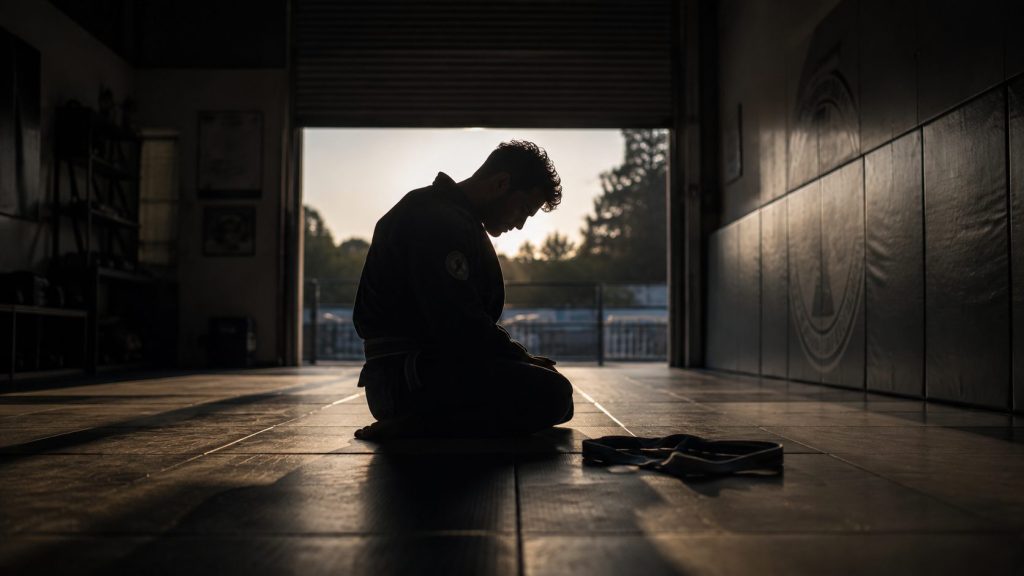
Most people don’t start Jiu-Jitsu because they want to get better at dealing with stress. They start because they want to learn how to defend themselves, get in shape, try something new, or maybe because a friend finally convinced them to come to a class. But after you’ve trained for a while, you start to notice something: the lessons you learn on the mat have a funny way of following you home.
Getting Comfortable Being Uncomfortable
Jiu-Jitsu puts you in uncomfortable situations on purpose. You’re stuck underneath side control, you’re exhausted, or you’re trying to remember a technique while another person is actively trying to stop you. At first, it can feel pretty overwhelming.
Most beginners tense up, hold their breath, use too much strength, and try to escape everything at once. Eventually, you learn to breathe, stay patient, and realize that being uncomfortable doesn’t mean you have to panic. Sometimes you’re going to be stuck in a bad position for a while. You protect yourself, stay calm, and look for the opportunity to improve your position.
It’s hard not to see the connection to everyday life. Stress puts us in situations we don’t want to be in, and our first instinct is often to react to everything at once. Jiu-Jitsu teaches us to slow down, breathe, and deal with what’s actually happening.
One Problem at a Time
We’ve all had days where everything seems to happen at once. Work is stressful, something at home needs your attention, your phone won’t stop going off, and your to-do list keeps getting longer. Trying to solve everything at once usually makes things feel even worse.
Jiu-Jitsu teaches you to deal with the problem directly in front of you. If someone has your back and is trying to choke you, you’re not thinking about how you’re going to submit them later. You protect your neck, deal with the grips, and work on escaping.
The same approach works surprisingly well outside the gym. Instead of getting overwhelmed by everything that needs to happen, ask yourself: What’s the problem I need to deal with right now? Handle that, then move on to the next thing.
Learning to Adapt
Jiu-Jitsu also teaches you that your plans aren’t always going to work. You can start a round determined to practice a particular technique, only for your training partner to do something completely different. Suddenly, the plan is gone.
So you adjust.
That’s a huge part of Jiu-Jitsu. You’re constantly making decisions based on what’s actually happening instead of what you hoped would happen. Life works the same way. Plans change, things go wrong, and circumstances outside your control can throw everything off.
The more you train, the more comfortable you become with adjusting. Changing the plan doesn’t mean you’ve failed. Sometimes it simply means the situation changed.
Getting Better at Failure
There’s no way around failure in Jiu-Jitsu. You get swept, passed, submitted, and caught making mistakes you knew you weren’t supposed to make. Nobody enjoys getting tapped, but after you’ve trained long enough, it stops feeling like such a big deal. You tap, figure out what happened, and start again.
Over time, you start treating mistakes as information. Why did that happen? What did I miss? What can I do differently next time?
That’s a valuable lesson outside the academy too. Not everything you try is going to work. You’re going to make mistakes and sometimes come up short. Jiu-Jitsu teaches you that a bad round doesn’t have to become a bad night. You learn from it, reset, and try again.
Progress Doesn’t Always Feel Like Progress
Anyone who has trained for a while knows there are stretches where you feel like you’re getting worse instead of better. Everyone seems to be catching you, and techniques that worked last month suddenly aren’t working anymore.
Then one day someone puts you in a position that used to make you panic, and you calmly work your way out. That’s when you realize you’ve been improving the whole time.
Life can be the same way. We don’t always notice growth while it’s happening. Sometimes you only recognize how much you’ve changed when you face something that would have overwhelmed you a year ago and realize you’re handling it differently.
Focus on What You Can Control
Jiu-Jitsu makes it pretty clear that there are plenty of things you can’t control. You don’t get to choose the size, strength, speed, or skill level of everyone you train with. You can’t control what your training partner is going to do.
What you can control is how you respond. You can control your effort, whether you panic, whether you’re willing to learn, and whether you come back tomorrow.
Life is full of things outside our control too. Spending all of our energy wishing those things were different usually doesn’t accomplish much. Sometimes you simply have to accept the position you’re in and start working from there.
An Hour Where Everything Else Disappears
There’s also something great about the fact that Jiu-Jitsu forces you to be completely present. When somebody is trying to choke you, you’re probably not thinking about the email you forgot to answer or tomorrow’s meeting. You’re right there, dealing with what’s happening in that moment.
You can walk into the academy after a rough day, train hard, laugh with your teammates, learn something new, and leave feeling completely different. Whatever was bothering you before class might still be there. Jiu-Jitsu didn’t magically solve it, but somehow it doesn’t feel quite as heavy anymore.
The Lessons Leave the Mat With You
Jiu-Jitsu won’t make your life stress-free. You’re still going to have bad days, make mistakes, and occasionally feel overwhelmed. The difference is that you’ve practiced being uncomfortable before.
You’ve been tired and still found a way to think. You’ve been stuck and figured out how to move. You’ve failed and started over. You’ve learned that sometimes the answer isn’t to fight harder. Sometimes it’s to breathe, stay calm, and make the next good decision.
You walk through the doors because you want to learn Jiu-Jitsu. Then somewhere along the way, Jiu-Jitsu starts teaching you how to handle everything else.