
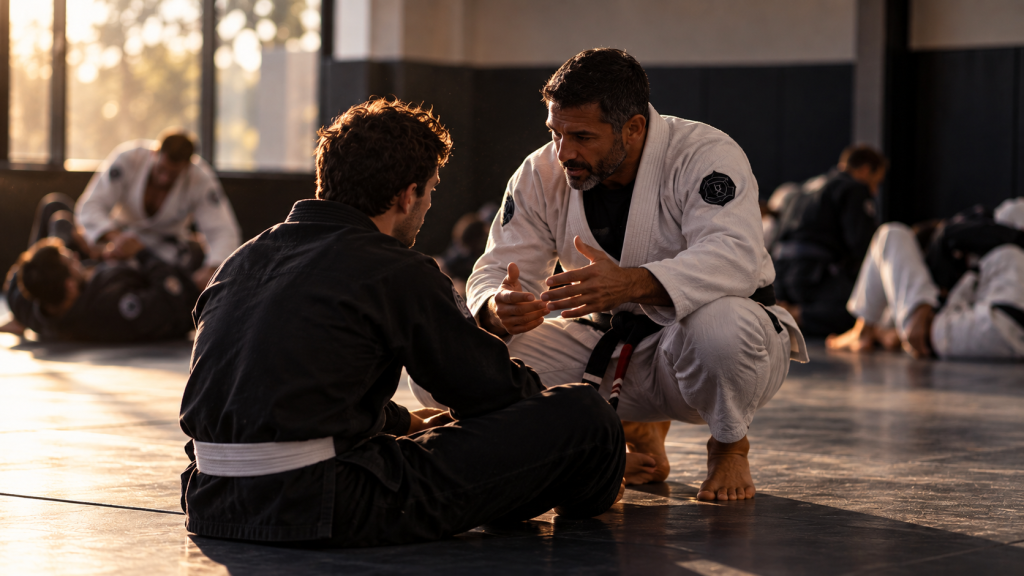
One of the hardest things to develop in Jiu-Jitsu has nothing to do with learning a new guard, improving your passing, or finishing a submission. It’s learning to trust the process, and a big part of that means learning to trust your coach.
When you train Jiu-Jitsu, you experience your progress from the inside. You remember the rounds where you struggled. You know which techniques still feel awkward. You notice when someone you used to have success against suddenly gives you problems. Because you’re living through every high and low, it can sometimes be difficult to see how much you’re actually improving.
Your coach sees your Jiu-Jitsu differently. They see where you started. They see how you move today compared to six months or two years ago. They see the mistakes you’ve stopped making, the positions where you’ve become more comfortable, and the areas of your game that still need time. Most importantly, they see your development in the context of years of watching other students go through many of the same stages.
That perspective is one of the reasons learning to trust your coach matters.
What Does It Mean to Trust Your Jiu-Jitsu Coach?
Trusting your coach doesn’t mean never asking questions or blindly agreeing with everything you’re told. Good Jiu-Jitsu is built on curiosity. You should ask why something works, explore different positions, and develop a game that fits you.
Trust means understanding that your coach may see something in your development before you do. Sometimes that means encouraging you to spend more time in a position you don’t particularly enjoy. Sometimes it means pointing out a fundamental problem when you would rather learn something new. Other times, it may simply mean telling you to keep doing exactly what you’re doing and give it more time.
That last one can be surprisingly difficult. We naturally want solutions. If something isn’t working, we want to know what to change. But not every problem in Jiu-Jitsu is solved by adding another technique. Sometimes you already have the right tools and simply need enough repetitions and live rounds for them to become part of your game.
A coach who knows your Jiu-Jitsu can help recognize the difference.
Your Coach Sees More Than a Single Round
It’s easy to judge your Jiu-Jitsu based on what happened during training that day. Maybe you had a great night and everything seemed to work. You hit your sweeps, your passing felt sharp, and you caught submissions you normally struggle to finish. You leave the academy feeling like you’ve taken a huge step forward.
Then two days later, nothing works. Someone passes your guard repeatedly. A position you thought you understood suddenly falls apart, and you spend most of your rounds defending.
Neither night tells the whole story.
Your coach isn’t evaluating your development based on one great round or one difficult round. They’re watching patterns develop over time. They see whether your decision-making is improving, whether you’re becoming more efficient, and whether you’re beginning to understand positions rather than simply reacting to them.
That wider perspective is important because Jiu-Jitsu progression rarely happens in a straight line. Sometimes you feel like you’re improving rapidly. Other times you may spend months feeling like you’re standing still. Often, you’re still improving during those periods. You just can’t see it yet.
Trust Your Coach When Progress Feels Slow
Almost everyone who trains long enough eventually reaches a point where they feel stuck.
Early in Jiu-Jitsu, improvement can feel dramatic. You’re learning something new almost every class. Positions that made no sense begin to become recognizable, and even small amounts of experience can create noticeable changes in your game.
As you become more experienced, those improvements can become harder to see. The difference between where you are today and where you were yesterday might be almost impossible to notice. That doesn’t mean you’ve stopped progressing.
At blue belt and above especially, improvement often becomes about refinement. Your movements become smaller. Your timing gets better. You begin anticipating reactions instead of waiting for them. You recognize problems earlier and make adjustments before a position completely breaks down.
These changes happen gradually, and your coach may notice them long before you do. That’s why one of the best things you can do when progress feels slow is keep communicating with your coach. Ask what they see. Ask where you should focus your attention. Then give yourself enough time to actually work on it.
Coaching Isn’t Always About Giving You More
Sometimes the best coaching is telling you that you don’t need anything new.
Jiu-Jitsu offers an almost endless amount of information. Between classes, instructionals, social media, competition footage, and techniques shared online, it’s possible to consume more Jiu-Jitsu than you could ever realistically develop into a functional game. That can create the feeling that improvement always requires adding something.
Another guard. Another submission. Another passing system. Another variation.
But your coach may look at your game and see something completely different. Instead of needing ten new techniques, maybe you need to get significantly better at the three you already use.
There is a huge difference between knowing a technique and owning it. Owning a technique means understanding the reactions it creates, knowing the adjustments when someone counters it, and being able to find it against different opponents without forcing the position.
That depth takes time, and sometimes a coach’s job isn’t to give you more. It’s to help you go deeper.
Trust Your Coach With Your Jiu-Jitsu Promotions
This is where trusting your coach connects directly with promotions.
It’s natural to wonder when your next stripe or belt is coming, especially when you feel like you’ve made significant progress. But your coach is looking at more than how long you’ve worn your current belt. They’re looking at your overall development.
That can include your technical understanding, consistency, ability to apply your Jiu-Jitsu against resistance, awareness during rounds, and how your game has matured over time. At more advanced levels, those things become increasingly difficult to measure with a simple checklist.
If your coach believes you need more time before your next promotion, that doesn’t erase the progress you’ve already made. It means there is still development happening at the level you’re currently at.
That additional time can be valuable. Instead of viewing it as waiting for your next belt or stripe, use it as an opportunity to become undeniable at the level you’re already wearing. When the promotion eventually comes, you’ll be ready for it.
A Good Coach Wants You to Become Better Than You Are Today
A healthy coach-student relationship isn’t about creating dependence. A good coach should help you become increasingly capable of understanding your own Jiu-Jitsu.
Over time, you should become better at identifying your mistakes. You should begin recognizing why positions are breaking down and making adjustments on your own. Your questions should change as your understanding becomes deeper.
The goal isn’t to need your coach to solve every problem forever. It’s to develop the knowledge and awareness to participate in your own development while still benefiting from the perspective of someone who can see your game from the outside.
That relationship becomes especially valuable as you progress. Your coach may eventually know your tendencies so well that a small observation can completely change the way you approach a position. But that only works if you’re willing to listen, experiment, and give their advice enough time to work.
Trust Doesn’t Mean You Stop Thinking for Yourself
There is an important distinction between trusting your coach and turning off your own judgment.
Jiu-Jitsu is personal. Your body type, athletic ability, age, injuries, personality, and preferences will influence the game you eventually develop. Not every technique will become part of your Jiu-Jitsu, and that’s okay.
Your coach provides direction, experience, and perspective. You still have to do the work of discovering how that guidance applies to you.
Ask questions. Be curious. Experiment during training. Pay attention to what works and what doesn’t. Talk to your coach when you’re struggling with something.
Trust works best when communication goes both ways.
Give Your Jiu-Jitsu Time to Develop
Sometimes the hardest advice to hear is also the simplest: keep training.
There isn’t always a shortcut or a hidden technique you’re missing. You may already be doing the right things. You may simply need another hundred rounds for everything to start coming together.
That’s difficult to appreciate when you’re in the middle of it. Your coach has probably watched other students experience the same frustration. They’ve seen people struggle with a position for months before something suddenly clicks. They’ve watched students question their progress and then make enormous jumps in their understanding.
They’ve also watched people rush the process.
Jiu-Jitsu has a way of rewarding patience. Techniques need time. Timing needs time. Confidence needs time. Learning how to stay calm and make good decisions against someone actively trying to stop you definitely takes time.
Some things simply can’t be rushed.
Trust Your Coach, Trust the Process, and Keep Training
Your coach can’t do the work for you. They can teach you, challenge you, correct you, and point you in the right direction, but you still have to show up and put in the mat time.
That’s where trust and personal responsibility meet.
Listen to your coaches. Ask questions when you don’t understand something. Take their feedback seriously, even when it isn’t necessarily what you wanted to hear. Then go test that guidance on the mats.
Some days you’ll feel like you’re making huge progress. Other days you’ll wonder whether you’ve learned anything at all. Keep going.
Your Jiu-Jitsu isn’t defined by a single class, a difficult round, or how quickly someone else progresses. It’s built slowly through years of showing up, learning, making mistakes, and refining what you already know.
Sometimes you’re too close to your own journey to recognize how far you’ve come. That’s one of the reasons you have a coach.
Trust their perspective, trust the work you’re putting in, and give your Jiu-Jitsu the time it needs to grow.