
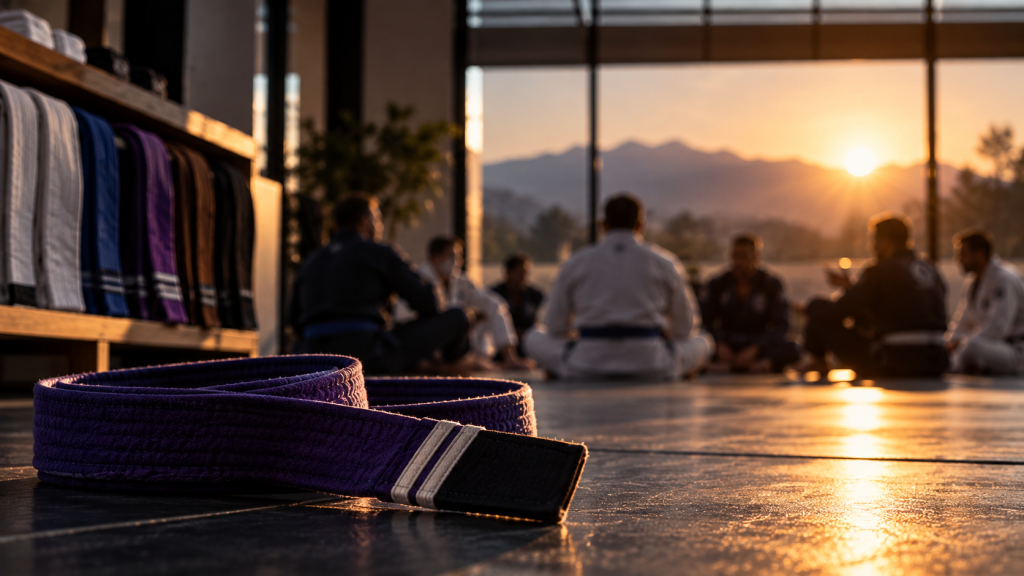
Promotions are one of the most memorable parts of training Jiu-Jitsu. Whether it’s receiving a stripe, earning a new belt, or eventually reaching black belt, being promoted is recognition of the work you’ve put in and the progress your coaches have seen in you. Those moments are important, and they should be celebrated. At the same time, promotions are only milestones in a much longer journey, and learning how to view them in the right perspective can be just as important as earning them.
The longer you train, the more you realize there isn’t a single timeline for progressing through Jiu-Jitsu. Everyone comes into the academy with different experiences, abilities, schedules, responsibilities, strengths, and weaknesses. Two people can begin training at the same time, attend many of the same classes, and still develop at completely different rates. That becomes especially noticeable as you progress beyond white belt, when advancement becomes less about simply learning new techniques and more about developing a deeper understanding of how and when to use them.
This is why one of the most important things you can learn in Jiu-Jitsu is that your journey is your own. Promotions can help you understand where you are along that journey, but they shouldn’t become the only way you measure whether you’re moving forward.
What Jiu-Jitsu Promotions Really Represent
A stripe or a new belt represents progress, but the promotion itself isn’t what created that progress. The real work happened during all the days leading up to it. It happened when you came to class after a long day and trained anyway. It happened during the rounds where nothing seemed to work, the nights when a technique finally started making sense, and the countless repetitions that slowly turned something you had to think about into something you could do naturally.
That distinction matters because it’s easy to begin looking at promotions as the goal rather than as recognition of the work you’re already doing. When that happens, your attention can shift away from learning and toward wondering when the next stripe or belt is coming. Jiu-Jitsu becomes much more enjoyable when the focus stays on improving your game and allowing the promotions to happen as a result of that improvement.
Rickson Gracie has often spoken about Jiu-Jitsu as a process of personal development rather than simply a pursuit of rank. That perspective is worth remembering because the belt around your waist tells part of the story, but it doesn’t capture everything happening on the mats. Your timing, confidence, awareness, ability to stay calm under pressure, and understanding of positions can all improve long before another stripe appears on your belt.
What Happens When You Don’t Get Promoted?
Promotion days are exciting, but they can also be difficult when you were hoping to be promoted and your name isn’t called. You might have been training consistently, competing, or feeling like your Jiu-Jitsu has improved significantly. When teammates receive stripes or belts and you don’t, it’s natural to start wondering what you’re missing.
Sometimes, however, you aren’t missing anything. You simply need more mat time.
This becomes increasingly important at blue belt and above. At those levels, progression isn’t always about learning another sweep, escape, or submission. You may already understand how a technique works. The next stage is refining it. Can you recognize the right moment to use it? Can you make adjustments when your opponent reacts differently than expected? Can you connect it to other parts of your game? Can you consistently execute it against training partners who know exactly what you’re trying to do?
That type of development takes time, and there isn’t always a shortcut. Sometimes another six months of rounds, mistakes, adjustments, and repetitions is exactly what your Jiu-Jitsu needs. Not receiving a promotion doesn’t necessarily mean you’re on the wrong path. In many cases, you’re already moving in the right direction and simply need more time for your technique and understanding to mature.
Saulo Ribeiro once said, “If you worry about the time and speed of your promotions, you lose yourself.” It’s a simple idea, but it captures something important about Jiu-Jitsu. When you’re constantly thinking about when you should be promoted, it’s easy to stop paying attention to all the progress happening between promotions.
Don’t Compare Your Jiu-Jitsu Journey to Someone Else’s
One of the hardest parts of progression can be watching someone else move forward when you feel like you should be moving with them. Someone who started after you may receive another stripe before you. A teammate you’ve trained alongside for years may earn the next belt while you remain at yours. It’s easy to turn those moments into a comparison, but someone else’s promotion doesn’t diminish your progress, and it doesn’t create a deadline for yours.
There are simply too many variables in Jiu-Jitsu for everyone’s progression to look the same. Some people train two days a week while others train five. Some compete regularly, while others have no interest in competition. Some arrive with wrestling, judo, or other athletic experience, while others begin with no background at all. People also have careers, families, injuries, travel, and responsibilities outside the academy that affect how often they can train and how quickly they develop.
Even if two people train exactly the same amount, they may still learn differently. One person may develop an effective guard quickly while spending years improving their passing. Someone else may experience the exact opposite. That’s part of what makes Jiu-Jitsu so individual. Instead of using another person’s progress to judge your own, celebrate their promotion and then continue working on your game. Their journey belongs to them, and yours belongs to you.
Don’t Rush Through the Belt You’re Wearing Today
Life moves pretty fast, and if you’re not careful, Jiu-Jitsu can become another place where you’re always thinking about what’s next. You receive one stripe and start wondering about the next. Eventually, you begin thinking about your blue belt. Once you’re a blue belt, purple becomes the next goal, followed by brown and eventually black.
There’s nothing wrong with wanting to progress. Having goals is healthy, and earning a new stripe or belt can be incredibly motivating. The problem comes when you’re so focused on the next level that you stop appreciating the one you’ve already earned.
If you’re a blue belt, enjoy being a blue belt. If you’re a purple belt, enjoy being a purple belt. There will eventually be a day when you tie that belt around your waist for the last time. You don’t get those years back, and there’s no reason to rush through them simply to reach the next color.
Instead of constantly asking when your next promotion will happen, ask yourself how good you can become at the level you’re at right now. There is something freeing about approaching Jiu-Jitsu that way. Your attention moves away from something you can’t completely control and back toward something you can: showing up, training consistently, learning, and becoming a little better than you were before.
Learn to Appreciate the Small Progressions
Some of the best signs that your Jiu-Jitsu is improving will never come with a stripe. Progress might be escaping a position that used to trap you every round, recognizing a submission early enough to defend it, or staying calm in a bad position where you once would have panicked. It might be hitting a sweep you’ve spent months working on or realizing that you’re beginning to understand why a technique works instead of simply remembering the steps.
Sometimes progress is even quieter than that. You may find yourself helping a newer student with something you remember struggling to understand yourself. You may notice that you’re making fewer unnecessary movements or conserving your energy better during rounds. These aren’t dramatic moments, and there probably won’t be a ceremony afterward, but they’re evidence that your Jiu-Jitsu is developing.
Those small improvements are what eventually become big improvements. They accumulate through hundreds and eventually thousands of hours on the mats. A promotion recognizes that development at certain points along the way, but the development itself is happening every time you train.
Black Belt Isn’t the End of the Jiu-Jitsu Journey
For many people who begin Jiu-Jitsu, black belt feels like the destination. It represents years of training and an incredible level of commitment to the sport. Earning one should absolutely be celebrated, but anyone who has spent enough time around experienced black belts knows that reaching black belt doesn’t mean you’ve learned everything there is to know.
There will always be another detail to discover, another position to improve, and another weakness in your game to work on. Your Jiu-Jitsu will continue changing as your body, training partners, and the sport itself evolve. Techniques that weren’t part of your game five years ago may eventually become some of your strongest positions.
That’s one of the beautiful things about Jiu-Jitsu: there really isn’t a finish line.
If you’re still going to be learning when you reach black belt, there’s no reason to rush through everything that comes before it. There is value in spending time at every level. There is value in struggling with techniques before understanding them and in having your game tested and refined through thousands of rounds. More time between stripes or belts isn’t wasted time. It’s still time spent becoming better at Jiu-Jitsu.
Promotions Matter, But They’re Only Part of the Journey
When you receive a stripe or a new belt, be proud of it. Enjoy the moment and appreciate what it represents. Your coaches have recognized the work you’ve put in and the progress you’ve made, and that’s something worth celebrating.
When a promotion doesn’t happen, try to look at that moment with the same perspective. It doesn’t erase the progress you’ve made, and it doesn’t necessarily mean you’ve done something wrong. Keep showing up. Keep putting in the mat time. Keep refining your techniques and working on the areas of your game that need attention. Sometimes the difference between where you are today and where your coaches want you to be is simply more time and experience.
Most importantly, don’t let stripes and belts become the reason you train. They’re an important part of Jiu-Jitsu, but they’re not the whole game. The friendships you build, the difficult rounds, the mistakes, the breakthroughs, the confidence you develop, and all the small improvements you experience along the way are just as much a part of the journey.
There will always be another technique to learn and another part of your game to improve. So celebrate the promotions when they come, keep training when they don’t, and don’t be in such a hurry to get to the next level that you forget to enjoy the one you’re at today.
Your Jiu-Jitsu journey is your own.