
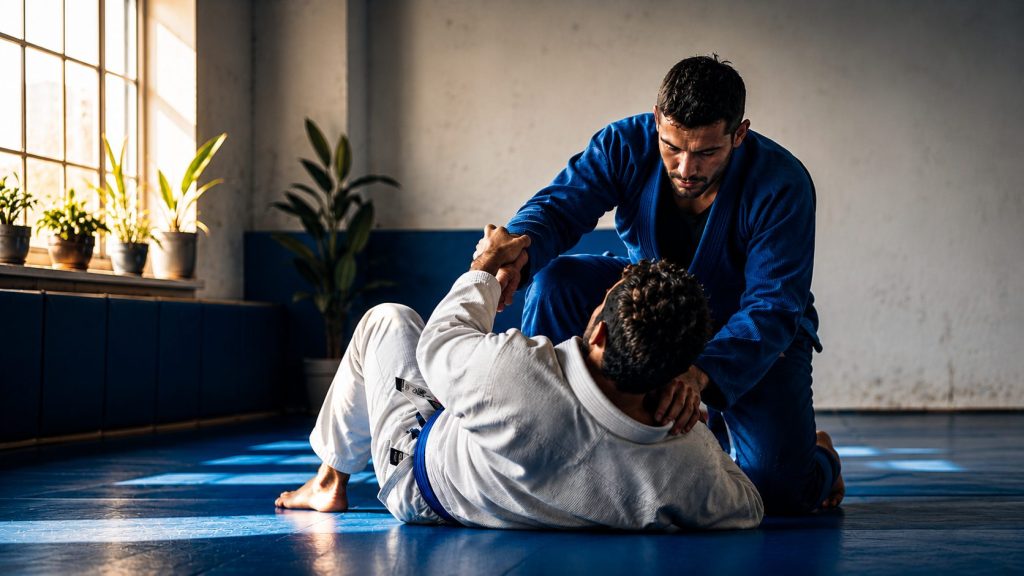
Jiu-jitsu is one of the only sports where you spend most of your training time holding another person’s joints at or near their limit. That’s not a side effect of the art; it’s the art. Which means every round on the mats carries a quiet, constant negotiation: how much force, how much speed, how much risk. Most of that negotiation isn’t verbal. It’s felt through grips, weight, and pace. And in almost every exchange, one person has more control over the outcome than the other. Understanding who that person is, and what they owe their partner in that moment, is one of the most underrated skills in the sport.
The injuries are happening in the room you train in, not the ones you compete in
It’s tempting to think of injury risk as something that shows up at tournaments, when adrenaline is high and athletes are pushing for a medal. The data says otherwise. Across BJJ injury research, roughly 85% of reported injuries occur during regular training, not competition. Separate survey work puts the six-month injury rate among practitioners at around 59%, and other studies estimate incidence at roughly 308 injuries per 1,000 athletes per year, or about 5.5 injuries per 1,000 hours of training. Knees account for the largest single share of injuries at around 27%, followed by shoulders at roughly 15%, with fingers and the neck rounding out the most commonly affected areas.
That distribution matters because it points directly at gym culture as the biggest lever available for injury prevention. Competition injury rates are shaped by rules, referees, and adrenaline that’s largely out of any one person’s hands. Training-room injury rates are shaped by decisions individual training partners make every single round: how hard to pass, how fast to finish a submission, whether to slow down when something feels off. That’s a controllable variable, and it sits with whoever holds the position of advantage at any given moment.
Whoever is in control carries more of the responsibility
In any exchange, one person is usually dictating pace, whether that’s the person passing guard, holding side control, or finishing a submission. The person underneath, defending, or being submitted has far less ability to modulate what happens to their own body in that instant. That asymmetry is why the responsibility for safety isn’t split fifty-fifty. The person applying pressure, weight, or a finishing lock has outsized influence over whether the round ends in a clean tap or an injury, which means they carry outsized responsibility for the outcome.
This shows up most clearly in leg entanglements. Heel hooks and other leg locks are notorious for causing injury not because the technique itself is inherently dangerous, but because the person applying it can generate a fast, high-torque finish before their partner has a chance to tap, especially if the partner is less experienced with leg lock defense or doesn’t recognize the danger of the position early enough. The same logic applies to knee-reaping positions, where IBJJF rules exist specifically because the mechanics can injure a joint faster than a partner can respond. The person controlling the position owes their partner a slower, more deliberate approach in exactly these situations, not because the technique is off-limits, but because the margin for error is smaller and the consequences land on someone else’s joint.
Top pressure carries a version of the same responsibility. A heavier or stronger athlete settling weight into side control or mount against a smaller or less experienced partner is making a choice, consciously or not, about how much force to apply. Passing a guard with control rather than jumping straight to maximum pressure, especially against a partner still learning to frame and defend, is not a concession of skill. It’s the baseline expectation that keeps a gym’s population healthy enough to keep training together.
The finish is the highest-responsibility moment
The moment a submission is actually locked in is where the stakes peak. Whoever is finishing the choke or the joint lock has full control over speed and torque, while their partner’s only tool is the tap. Applying steady, controllable pressure rather than exploding into a finish gives a partner the chance to tap before real damage occurs. Continuing to crank after feeling a tap, even for half a second, or resetting a submission with extra force after a partner taps out, converts a normal training exchange into an entirely avoidable injury. This is true regardless of belt level; a blue belt finishing a submission on a white belt has exactly the same responsibility as a black belt finishing one on another black belt.
The other side of that exchange matters too. Tapping early rather than testing how much a position can be escaped protects joints that have to last a lifetime of training, and it’s a form of respect toward a partner who is, in that moment, trusting you to end the exchange safely. But tapping culture only works if both sides hold up their end: a partner who taps early needs a partner who releases immediately, without hesitation or a final squeeze.
When something does go wrong
Injuries still happen even in a well-run room, and how the room responds afterward is its own test of the same principle. Stopping the round immediately, checking in verbally rather than assuming a partner is fine, and looping in an instructor are the baseline response to any injury, not just visibly serious ones. Encouraging a partner to push through pain, or resuming a round after a partner mentions something feels wrong, shifts an ordinary training injury into a preventable one. Given that the vast majority of BJJ injuries happen in exactly these day-to-day training rounds rather than in competition, the culture a gym builds around checking in, controlling pace, and respecting taps does more for practitioner safety than any rule change at the competition level ever could.
Jiu-jitsu asks a lot of trust from the people who practice it together. Taking care of a training partner isn’t a separate skill from being good at jiu-jitsu; it’s the thing that makes the rest of the training possible at all.